Pedestrian claims are usually fought over one question: did the walker have the right of way. Georgia law gives pedestrians the right of way in a marked crosswalk and at an intersection, but drivers and their insurers routinely assert the pedestrian "darted out". The answer lives in the scene — the point of impact, the throw distance and the driver’s available sightline.
Reviewed by Omar A. Cooper, Esq. · Last updated September 3, 2026
Who is usually responsible
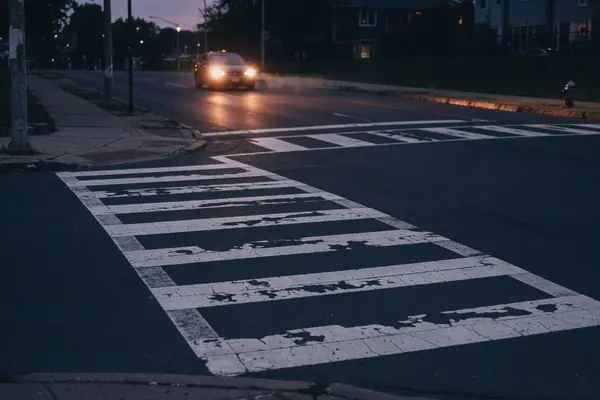
More than one party is often liable for a pedestrian collision, and finding the second one is frequently what changes the value of a claim:
- the driver, for failure to yield, distraction, or turning without looking;
- the driver’s employer, in a delivery or commercial vehicle;
- a property owner whose landscaping, signage or parking layout obscured the crossing;
- a road authority where a crossing was unlit, unmarked or unsafely designed — with the short government notice deadlines that come with it.
The evidence that decides these cases
In rough order of how quickly it disappears:
- the point of impact and where the pedestrian came to rest, which together indicate speed;
- crosswalk markings, signal timing and lighting at the actual time of day;
- nearby business and transit camera footage;
- the driver’s phone records where distraction is suspected;
- the emergency medical record, which documents mechanism of injury while it is fresh.
Much of metro Atlanta was built without continuous sidewalks, and people cross where the road makes them cross. That reality does not automatically make a pedestrian negligent, but it will be argued — and because Georgia bars recovery at 50 percent fault, that argument is worth answering carefully rather than conceding.
What can be recovered
- Economic lossMedical treatment already received and reasonably expected in future, lost wages, reduced earning capacity, and property damage.
- Non-economic lossPain, suffering, mental anguish, disfigurement and the loss of the things you used to be able to do.
- Punitive damagesAvailable in the narrower set of Georgia cases involving wilful misconduct or conscious indifference to consequences — drunk driving being the clearest example. They are not part of an ordinary negligence claim.
Every case is different and no outcome can be promised. What we can commit to is that the claim will be documented properly before anyone is asked to put a number on it.
What to do now
If a pedestrian collision has just happened, the order of these matters more than people expect:
- Get medical attention, and keep going. Your health comes first, and a documented, continuous treatment record is also what makes the injury provable later. Gaps are the argument insurers make most often.
- Report it. A police report, an incident report or an animal-control report creates a contemporaneous record that cannot be reconstructed afterwards.
- Preserve what will disappear. Photograph the scene, the vehicles or the hazard, and your injuries. Video is usually overwritten within days — a written request to preserve it has to go out early. Georgia crash reports are released through BuyCrash a few business days later.
- Do not give the other side a recorded statement before you have spoken to a lawyer and know the extent of your injuries. You are not required to.
- Get a free review. Call (470) 852-6328 and Omar will tell you honestly whether there is a claim.
The filing deadline is shorter than most people assume
Georgia generally allows two years from the date of injury to file suit (O.C.G.A. § 9-3-33), and once it passes the claim is gone regardless of merit. Claims involving a city, county or state agency are shorter still — written notice can be required within six to twelve months (O.C.G.A. § 36-33-5, O.C.G.A. § 36-11-1, O.C.G.A. § 50-21-26).
Sources: O.C.G.A. § 9-3-33 — injuries to the person: two years · O.C.G.A. § 51-12-33 — apportionment and comparative fault · Georgia crash reports — BuyCrash
Questions people ask about these claims
I was not in a crosswalk. Is my claim over?
No. Crossing outside a crosswalk can shift some fault to you, but it does not end the claim unless your share reaches 50 percent (O.C.G.A. § 51-12-33). Driver speed, lighting and sightline all bear on the split.
The driver left the scene.
That is a hit and run, and your own uninsured-motorist coverage generally responds. Report it to police promptly — the coverage usually depends on it.
Talk to Omar about pedestrian collisions.
Free, confidential and reviewed by the attorney. Call (470) 852-6328 or send the details.
Free Case Review
Share what happened — a member of our team will review your case at no cost.
☎ Call (470) 852-6328